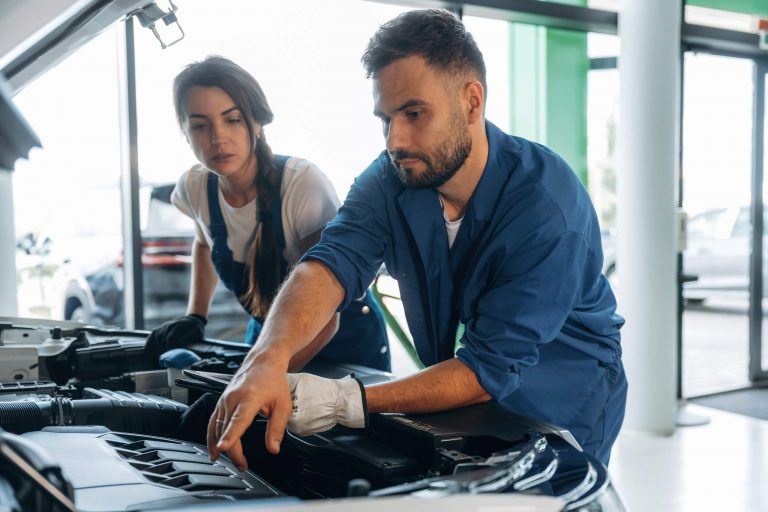

Today’s automobiles have evolved from purely mechanical devices into intricate electronic ecosystems governed by embedded sensors and computers. Consequently, the art of diagnosing vehicle trouble bears little resemblance to the methods used even thirty years ago.
Gone are the days of wild guesses and part-by-part swapping; technicians now employ precise instrumentation to pinpoint a car’s specific malfunctions.
Cars As Mobile Computers
Today’s automobiles operate as sophisticated computers. Each one comes equipped with an integrated system that continuously monitors its own condition. The car’s electronic brain keeps tabs on fuel economy, engine performance, exhaust emissions, temperature ranges and other variables. When any of these parameters deviates beyond normal specifications, the system saves a set of codes to pinpoint the cause.
The diagnostic process begins right there.
What Is an OBD System?
OBD, or On-Board Diagnostics, is the standard computer protocol most vehicles use. OBD serves as a communication portal that allows a technician to access and communicate with the car.
Technicians can utilize a diagnostic scanner with the following capabilities:
- Scan for any fault codes • Determine what sensor or system may be at fault • Get live information on engine performance
Rather than removing components to inspect or test, technicians get a head start on problem-solving by first viewing the data the car itself is providing.
The Purpose of Diagnostic Scanners
Using a scanner requires a technician to connect his or her scanner device to the OBD port on the vehicle to access the car’s computer for information.
The diagnostic scanner will be able to retrieve error codes, which represent the various problems that have occurred in different engine systems, including the emissions control system, the fuel delivery system and so on.
However, one caveat here:
An error code doesn’t necessarily point directly to the exact component that has failed. It does point out which component the system thinks is causing trouble, but that may not necessarily be the real culprit.
Hence, analysis is crucial.
Reading Live Data
In today’s world, a diagnostic tool’s value extends beyond just scanning for codes. You can actually view live data as the engine is running.
Live data will show you various metrics, such as:
- Engine RPM • Temperature readings • Fuel pressure • Various other sensors
By monitoring the car as it operates normally, the technician is better able to analyze how the vehicle is functioning.
Why Diagnostic Skills Are In High Demand
In today’s modern automotive industry, technicians are no longer allowed to guess when it comes to diagnosis. The systems are far too complex.
Possessing good diagnostic skills can:
- Reduce the time it takes to complete the repair job • Eliminate unnecessary repair procedures that aren’t actually needed • Identify the actual problems faster • Perform the repair jobs as they should be done
These are some of the most vital skills a modern day technician could have.
Summary
Car diagnostics require a blend of technological and mechanical knowledge. This is not about simply swapping out parts that might have failed but instead knowing what the data indicates, which will enable you to make accurate repair determinations.
Your better knowledge of diagnostics, the greater confidence and efficiency you will have as a technician.
In the automotive world of today, the true technician does not repair machines. He or she fixes problems.